Signals & Systems
-
Signal - function dependent on 1+ arguments, usually describing a physical aspect of something
-
One-dimensional signal - 1 argument
-
Multi-dimensional signal - multiple arguments
-
DT signal - sequence
-
CT signal - waveform
-
Sampling turns a CT into a DT (analog to digital)
-
Sample every T (sampling interval).
- Sampling rate 1/T
-
- Reconstruction turns a DT into a CT (digital to analog)
-
-
System - takes a signal and outputs a new signal
-
-
Properties of a signal, denoted x(t)
- Energy
-
Power
-
Power is average energy
-
When periodic, for any
-
-
Random - involves probability
Deterministic
-
Properties of a system, denoted H
-
Stability
- BIBO stable (bounded-input bounded-output stable) - iff
-
Memory
-
Memoryless if y[t] is only based on x[t]
-
Has memory if y[t] based on x[not t] (such as x[t-1])
-
-
Invertibility
- is invertible iff there exists system such that if then
-
Time-invariance
-
Time-invariant iff t-shift then apply H is the same as apply H then t-shift. Time-variance means that it depends on absolute time.
-
t-shift then apply H:
-
apply H then t-shift:
-
Strategy when checking if time-invariant: write to apply and first find then t-shift by
-
-
Time-variant - H applies a change to x(t) differently based on each absolute t
-
Common examples
-
Variant - depends on absolute time
-
-
Invariant
- y(t)=x(t-5)
-
-
-
Linearity
- Linear iff
-
Causality
- Causal iff y(t) dependent on only present and past values of x, that is
-
Real
- A real system maps real inputs to real outputs
-
-
Singularity functions is either or has no derivative at a point
-
Example signals
-
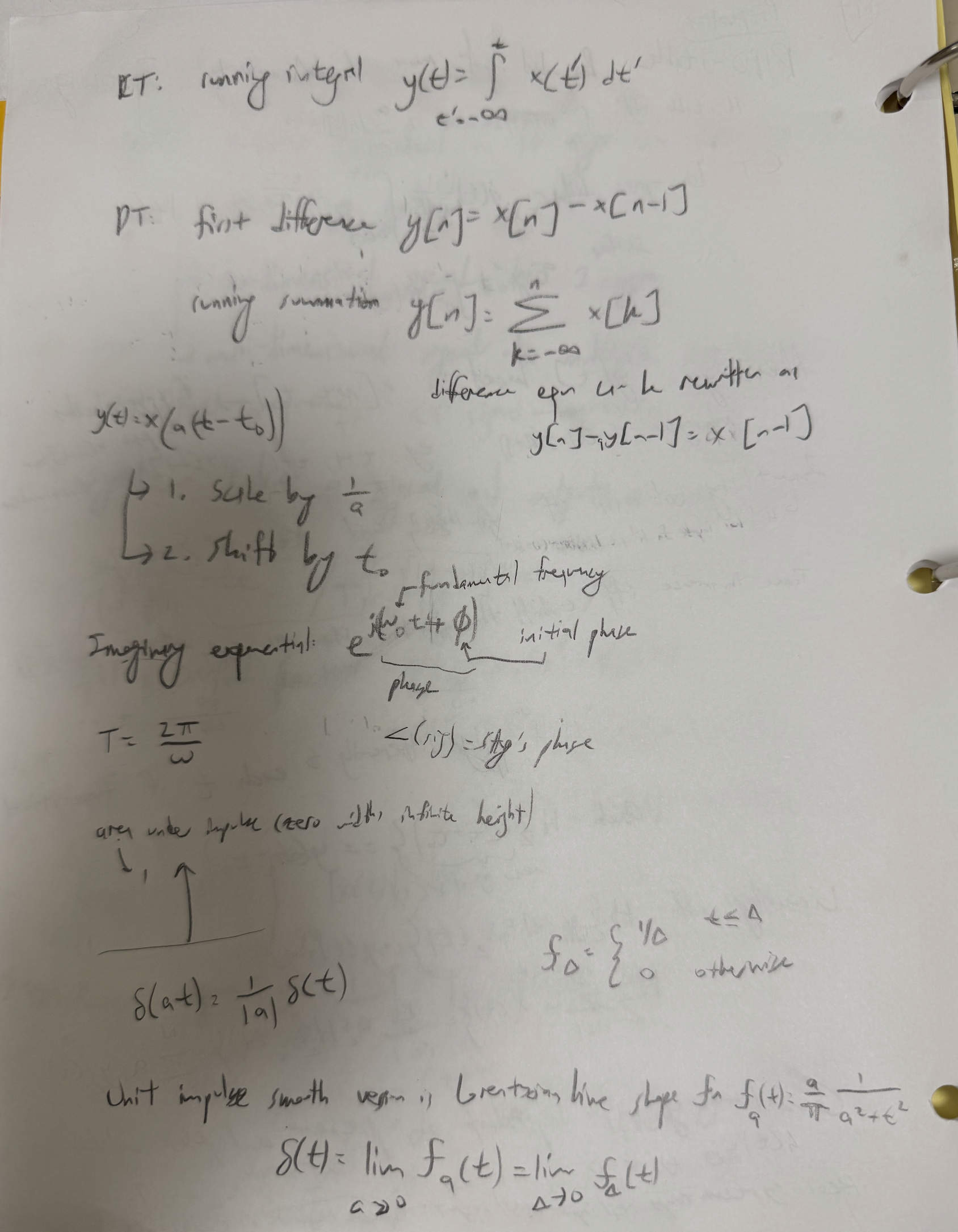
Impulse function
-
CT impulse function is also called the Dirac delta function (see explanatory video here)
-
Unit doublet function
-
-
Step function is 1 if else 0
-
Ramp function
-
Rectangular pulse
-
-
Example systems
-
Modulation
-
- is the carrier frequency
-
-
High-pass and low-pass filters
-
DT
-
Difference equation:
-
When , low-pass filter
When , running sum
When , compound interest
When , high-pass filter
- Impulse response
-
-
-
-
CT low-pass filter
-
Differential equation:
-
-
Impulse response
-
- Frequency response
-
-3 dB is when the power is down by 1/2 which would correspond to being which would correspond to or so cutoff frequency
-
CT high-pass filter
- Differential equation:
-
-
Impulse response
-
Frequency response
-
Squarer
-
DT
-
CT
-
-
Initial rest - until is non-zero
-
Fundamental frequency
Frequency
-
is a harmonic when is an integer
-
is the first harmonic (the fundamental frequency)
-
is the second harmonic - twice the fundamental frequency
-
-
-
Convolutions
-
Convolving two signals—a(t) and b(t)—returns another signal c(t)
-
CT
-
DT
-
Convolution is linear
-
Convolution is commutative
-
-
Given an LTI system H
-
Impulse response
-
-
Step response
-
How to calculate convolution
-
Method 1: Flip and drag
-
Plot
-
Plot (which is , a horizontal flip and then transform right by n)
-
For each fixed value of n, take each k and multiply the two graphs, adding up all these terms to get
-
-
Method 2: Express rectangles as singularity functions and apply special functions
-
Method 3: symbolically
-
-
Useful examples
-
running sum
- convolving with the step function gives a running sum
-
-
identity
- convolving with the impulse function returns the identity
- delay
- derivative
-
This is a useful property to check that you did your convolution correctly
-
Frequency response
-
AKA transfer function
-
If then
-
How to calculate: through the equation given above with the impulse response or by substituting in as and with
-
Properties
-
If impulse response is real,
-
-
Any real will yield a real
-
Properties
-
Sampling property
- mn you sample that point
-
Sifting property
-
DT
-
CT
-
mn sifting through the points for the one point (like sifting through water for that one piece of gold)
-
-
Finite
-
-
Linear, constant-coefficient differential (CT)/difference (DT) equation
-
DT
-
CT
-
-
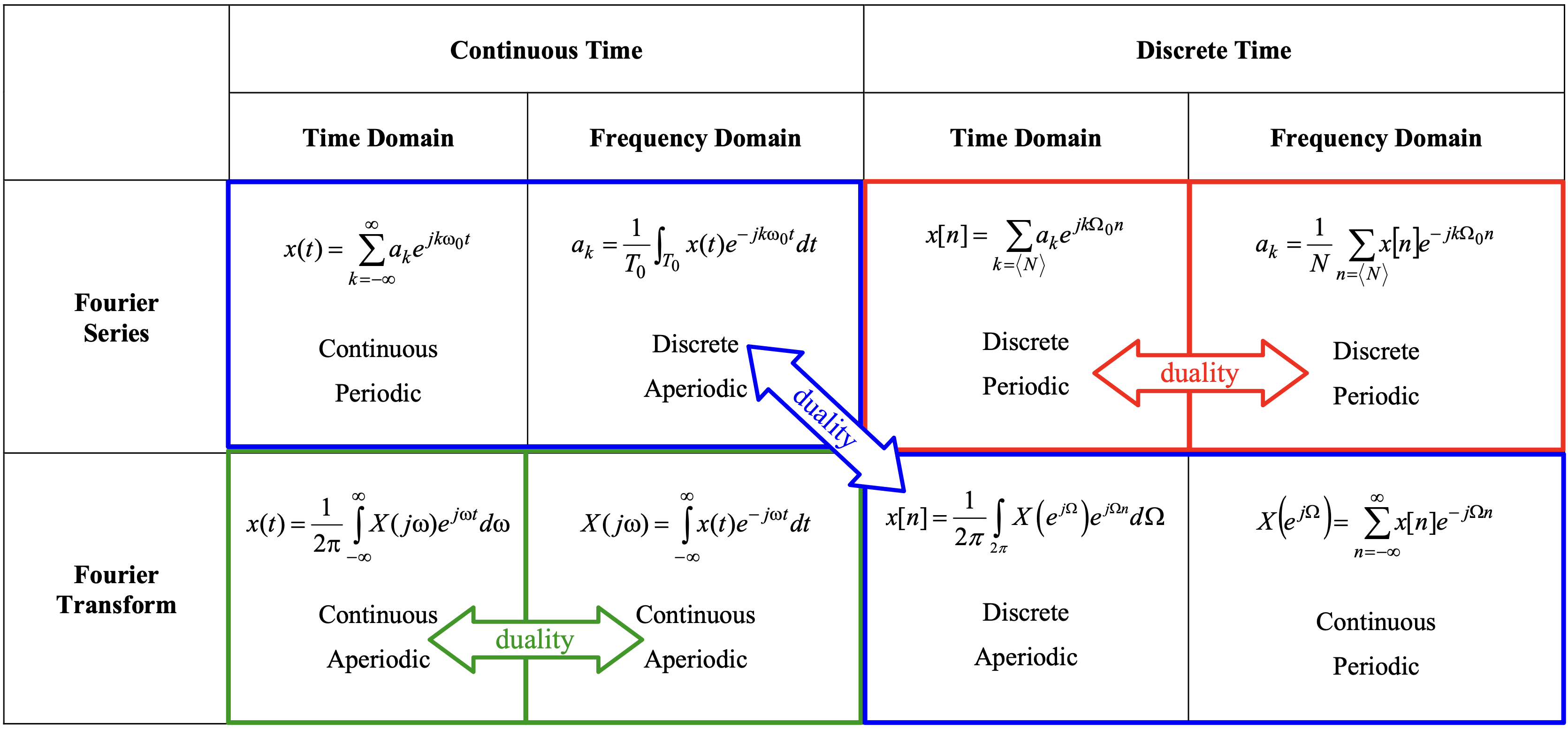
Signal transforms (frequency-domain transforms)
-
Fourier series - for periodic signals (have power)
-
Fourier series - CTFS
-
Discrete Fourier series - DTFS
-
-
Fourier transform - for aperiodic signals (have energy)
-
Fourier transform - CTFT
-
Discrete Fourier transform - DTFT
-
-
Laplace transform - CT
-
Z-Transform - DT
-
-
Fourier series
-
Basis function
-
Synthesis - representing a signal by a Fourier series
-
Analysis - finding the Fourier series coefficients to represent a signal
-
-
mn is the product of inner product of and (approximation of x(t) with linear combo of exponentials) over one period, which is the RHS.
mn
LHS yields
-
Examples
- Pulse train:
- DT pulse train for period and pulse width
-
DT version
-
Basis function
-
Synthesis
-
Analysis
-
Fundamental frequency
-
-
-
With LTI system H
- If and then due to linearity of H
-
Properties given and
-
Both
- Linearity
-
- Power
- If is real,
- If is even and real, is even and real. If is odd and real, is odd and imaginary
- T-shift delay: if
-
CTFS
- Parseval's identity - relates the inner product of two signals to their FS coefficients
-
Group delay - how delayed (phase-shifted) the components are based on their frequency
-
Continuous-time Fourier transform (CTFT)
-
CTFT
-
AKA analysis equation ∵ analysis is extracting coeffs
-
- where is for aperiodic signal version (one period) and is for periodic signal (CTFS coeff)
-
-
Inverse CTFT
-
-
AKA CTFT synthesis equation ∵ synthesis is synthesizing signal from coeffs
-
mn synthesis has + because synthesis is about creating (positive) whereas analysis is about taking apart (negative) so it has a -
-
This means that for frequency response ,
so the phase distortion tells you how much the frequencies are delayed
-
Notation
-
CTFT operator : and
-
CTFT pair:
-
-
Eigenfunction of CT LTI system is
-
If the Dirichlet conditions (below) are satisfied, then synthesized signal except near when has discontinuities and the energy difference between them vanishes:
-
is absolutely integrable
-
) has a finite number of local minima and maxima in a finite interval
-
has a finite number of discontinuities in a finite interval
-
's discontinuities are all finite
-
-
Examples
- From CTFS:
- Impulse train:
-
-
Properties
- Linearity:
- Time scaling:
- Corollary:
- Time shift
-
Corollary: if a signal x(t) is real, its CTFT has conjugate symmetry
-
If is real and even, is real and even
If is real and odd, is imaginary and odd
- (differentiation)
- (frequency shifting)
- Parseval's identity: , which is
- Energy of x(t) is , which is also
-
DTFS
-
- analysis
-
-
Eigenfunction of DT LTI system is . When , we can use
-
-
DTFT
-
Additional Notes
- Conjugate symmetry: means has conjugate symmetry
-
Helpful math
-
- Conjugation distributes:
-
Inner product
- CT version of dot product (DT)
-